

In the field of automobile manufacturing, welding is like “bones connection”, which directly determines the structural strength and service life of parts. With the acceleration of new energy vehicles and lightweight trends, sheet metal welding technology is undergoing a leapfrog upgrade from traditional manual to intelligent. This article will deeply analyze the five major mainstream welding technologies and reveal how to achieve millimeter-level precision control of automobile chassis welding.
Comparison of the five major mainstream welding technologies: matching scenarios can create value
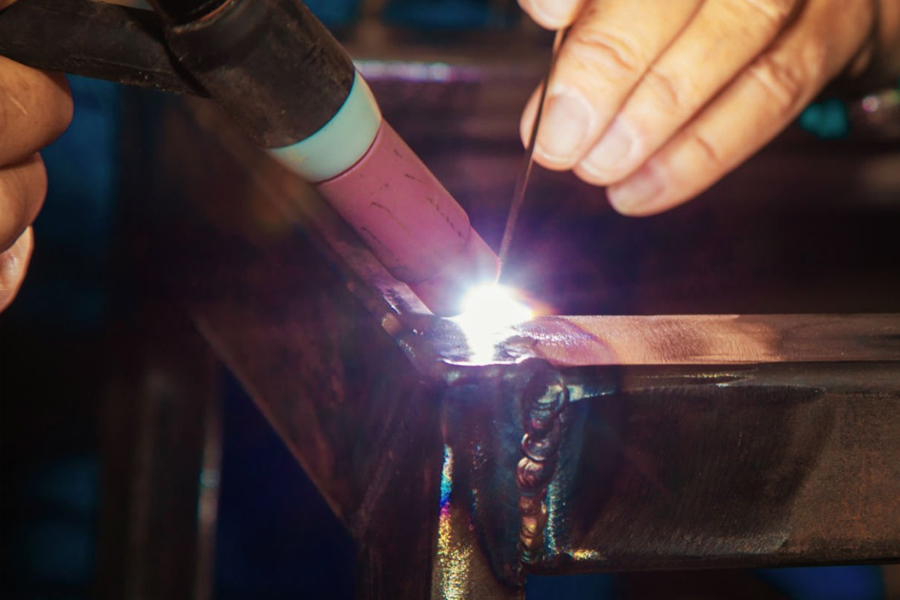
TIG welding (TIG)
- Principle: Use argon gas to protect the arc and melt the parent material and welding wire.
- Advantages: Beautiful welds, suitable for thin plates (0.5-3mm);
- Limitations: Slow speed (about 15cm/min), high labor costs;
- Applicable scenarios: Stainless steel medical equipment shells, automotive skin decorative strips welding.
Resistance spot welding
- Principle: Heat is generated by pressurizing electrodes and energizing them to weld the plates.
- Advantages: high efficiency (single-point welding 0.5 seconds), no welding materials required;
- Limitations: only suitable for overlapping structures, the strength of the weld depends on pressure control;
- Applicable scenarios: mass production of door hinges and body panels.
Laser welding
- Principle: high-energy laser beam instantly melts the material to achieve connection.
- Advantages: accuracy ±0.1mm, narrow heat-affected zone, speed up to 60cm/min;
- Limitations: high equipment investment (over 3 million yuan), sensitive to assembly gap;
- Applicable scenarios: battery tray sealing welding, high-end car sheet metal manufacturing.
MIG/MAG welding
- Principle: continuous wire feeding arc welding under inert/active gas protection.
- Advantages: large penetration depth, suitable for medium and thick plates (3-12mm);
- Limitations: more spatter, need subsequent cleaning;
- Applicable scenarios: welding of commercial vehicle frames and bus chassis processing structural parts.
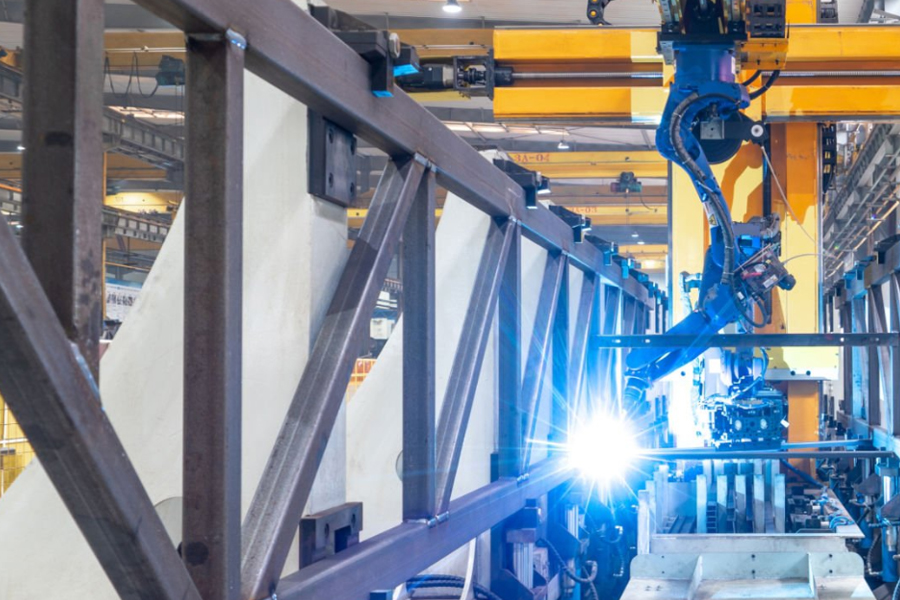
Robot welding
- Principle: six-axis robotic arm equipped with welding gun, programmed and precise operation.
- Advantages: Repeatability ±0.05mm, support for 24-hour continuous production;
- Limitations: Time-consuming early programming and debugging;
- Applicable scenarios: complex curved body welding, automobile chassis welding batch orders.
Automobile chassis welding process: dual test of strength and reliability
As the core load-bearing component of the vehicle, automobile chassis sheet metal processing places strict requirements on welding process:
Strength test standard
- Tensile strength: The weld strength must reach more than 90% of the parent material (refer to GB/T 2651);
- Fatigue test: simulate 200,000 bumpy road cycles without cracks;
Nondestructive testing (NDT) process
- Ultrasonic testing: detect internal pores, unfused and other defects;
- X-ray flaw detection: detect weld density and cracks;
- Penetrant testing: locate surface micron-level defects.
Process certification system
- Comply with IATF 16949 quality control standards;
- Welding operators must hold AWS/ISO 9606 certification;
- Welding material suppliers pass NADCAP aerospace qualification review.
Breakthrough of industry pain points: 0.1mm level welding deformation control solution
In the process of sheet metal welding, deformation caused by heat input is the biggest challenge. We achieve precision control through three major technologies:
Process parameter optimization
- Heat input control: Use pulse welding technology to reduce heat accumulation;
- Sequence planning: Predict deformation through simulation software and formulate symmetrical welding path;
Intelligent tooling fixture
- Hydraulic adaptive fixture: Real-time adjustment of clamping force to offset shrinkage stress;
- Cooling system: Add water-cooled copper plate on the back of the weld to locally cool down by 50℃.
Post-correction technology
- Laser calibration: Generate deformation compensation model through 3D scanning;
- Mechanical shaping: Use servo press to fine-tune deviation with an accuracy of 0.05mm.
Why choose a professional sheet metal welding service provider?
- Technical accumulation: 10 years of automotive industry welding database, covering 300+ material combinations;
- Intelligent production line: Kuka robot + laser tracking system to achieve automatic correction of welds;
- Quick response: Support 48 hours of sampling to meet the verification needs of vehicle model changes.
From argon arc welding to robot welding, every technological breakthrough is reshaping the boundaries of sheet metal manufacturing, controlling with millimeter-level precision, and helping customers win market competition.