

In the world of modern manufacturing, metal fabrication plays a crucial role in shaping products that touch nearly every aspect of daily life — from electronics and appliances to automobiles and industrial machinery. Two core processes in sheet metal fabrication that often get mixed up are metal punching and metal stamping. While these techniques may seem similar at a glance, they are distinctly different in terms of operation, purpose, machinery, and applications.
For engineers, procurement specialists, and manufacturing decision-makers, understanding these differences is essential. It helps in selecting the right production process, optimizing cost-efficiency, and ensuring quality output that meets functional and aesthetic requirements.
This guide explains the fundamental differences between metal punching and stamping, their respective benefits, applications, machinery used, and how to choose the best process for your project.
What Is Metal Punching?
Metal punching is a subtractive fabrication method used to create holes or cutouts in a sheet of metal. It involves forcing a punch tool through the sheet material and into a die. The punch shears the metal, and the resulting shape — typically a hole — is the end product.
The punched-out scrap, known as a slug, is ejected or falls away. Punching is a high-speed and repeatable process, making it a go-to choice for mass production where speed and accuracy are crucial.
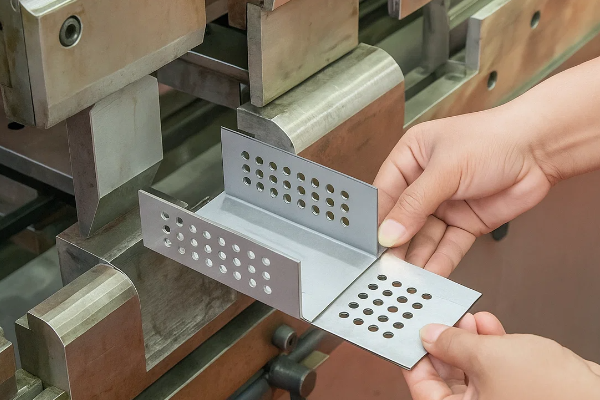
Key Characteristics of Punching:
- Typically used to create holes, slots, or other internal features
- Utilizes hard tooling (a punch and die set)
- Can be operated manually or through CNC turret punch presses
- Ideal for medium to high-volume production
- Minimal material deformation around the punched area
Common Punching Applications:
- Electrical enclosures (ventilation slots, cable entry holes)
- Control panels (button and switch cutouts)
- Brackets and mounting plates
- Automotive body components
- Sheet metal ducts and trays
What Is Metal Stamping?
Metal stamping is a comprehensive term that encompasses a range of processes where a sheet metal blank is shaped or deformed using a die. These processes include bending, embossing, flanging, coining, blanking, and more. Unlike punching, stamping doesn’t always remove material — instead, it can bend or compress it to form desired features.
Metal stamping often uses a mechanical or hydraulic press machine, where a stamping die applies pressure on the workpiece to shape or deform it according to a specific geometry.
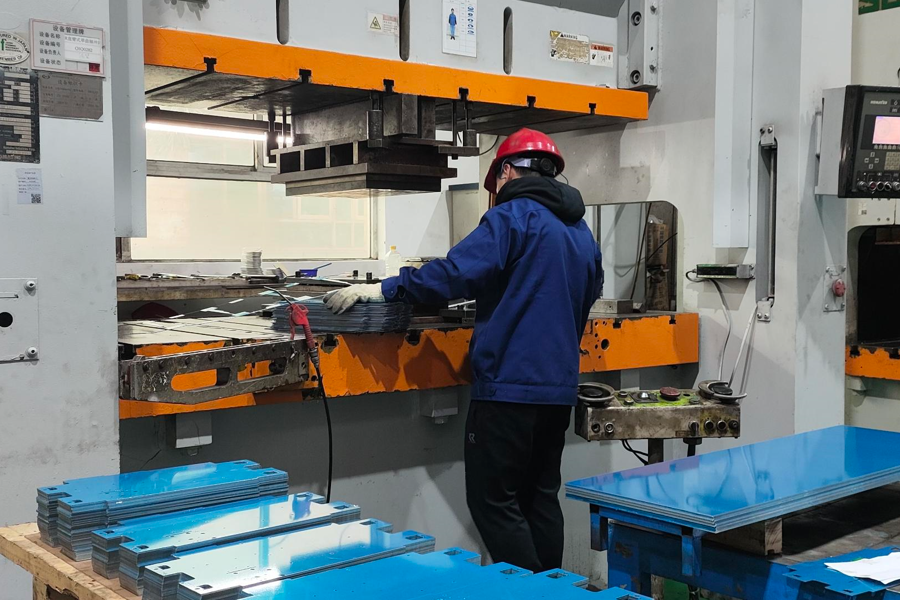
Key Characteristics of Stamping:
- Often includes bending, forming, embossing, or coining
- Can be progressive (multiple operations in one press cycle)
- High tooling costs but exceptionally low per-part cost at high volumes
- Creates 3D forms, not just 2D cutouts
- Used for both functional and aesthetic purposes
Common Stamping Applications:
- Automotive body panels
- Appliance housings
- Structural components with formed ribs
- Electrical connectors
- Battery casings and metal lids
Main Differences Between Metal Punching and Stamping
| Feature | Metal Punching | Metal Stamping |
| Material Removal | Yes — removes material (slug) | Not always — may bend, emboss, or form |
| Tooling | Punch and die set | Stamping dies (simple or progressive) |
| Machinery | Punch press or CNC turret | Mechanical or hydraulic stamping press |
| Shapes Produced | Internal cutouts (holes, slots) | Internal and external features, 3D forms |
| Volume | Suitable for medium to high volume | Economical for high volume production |
| Precision | High for hole-making | High for complex forming |
| Speed | Very fast for repetitive punching | Fast for progressive dies; slower for complex stamping |
| Tooling Cost | Lower | Higher (but justified in high volume) |
| Design Complexity | Limited to 2D features | Can create complex 3D features |
When to Use Punching vs. Stamping
Choosing between metal punching and stamping depends on several critical factors, including part design, material type, production volume, and cost constraints.
Use Metal Punching When:
- The part requires holes, slots, or similar cutouts
- You need quick turnaround times
- You want lower upfront tooling costs
- Design complexity is minimal or 2D features are sufficient
- You’re working with low- to medium-thickness metal sheets
Use Metal Stamping When:
- The part requires bends, embossing, or formed features
- You’re running high-volume production (e.g., 10,000+ units)
- Your design includes 3D contours or progressive features
- You need excellent repeatability across large batches
- You want to reduce downstream processes like welding or assembling
Machinery and Tooling Considerations
Punch Press Machines
Punch presses are available in both manual and CNC-controlled variants. CNC turret punches are the industry standard for flexible, programmable hole-making. They feature a rotating turret with multiple punch tools for varied shapes, allowing automation and high-speed operation.
Stamping Press Machines
Stamping presses are typically mechanical or hydraulic. Progressive die stamping systems are advanced solutions where multiple features are formed in one press cycle across several stations. While the initial die design is expensive and time-consuming, the cost per part drops significantly at scale.
Material Suitability
Both punching and stamping can be performed on a wide variety of metals, but your choice of process may depend on the material thickness and hardness.
Common Materials:
- Aluminum: Lightweight, corrosion-resistant, excellent for both punching and stamping
- Stainless Steel: Durable and rust-resistant, widely used in automotive and appliances
- Carbon Steel: Strong, low-cost option for structural components
- Brass & Copper: High conductivity makes them suitable for electrical components
Punching works well for metals between 0.5mm and 6mm thick, while stamping is versatile across a broader range, including ultra-thin foils and thick gauge materials.
Cost Comparison: Punching vs. Stamping
| Cost Factor | Punching | Stamping |
| Tooling Cost | Lower | Higher |
| Setup Time | Shorter | Longer |
| Production Rate | High | Very high (progressive dies) |
| Cost per Unit (Low Volume) | Lower | Higher |
| Cost per Unit (High Volume) | Moderate | Lower |
Metal punching offers a lower total cost for small-to-medium production runs. However, metal stamping provides a superior return on investment (ROI) in large-scale manufacturing where high-speed automation and minimal labor deliver cost savings.
Quality and Surface Finish
Both processes are capable of producing high-quality parts, but they differ in terms of finish and tolerances.
- Punching may leave slight burrs or sharp edges, especially in harder metals. These may require deburring or secondary finishing.
- Stamping offers better dimensional consistency and surface finish, especially when using precision dies and automated feeding systems.
For appearance-critical parts, such as consumer electronics or automotive interiors, stamping is often the preferred process.
Examples from Key Industries
Automotive:
- Punching: Brake shields, mounting plates, dashboard panels
- Stamping: Body panels, transmission parts, fuel tanks
Electronics:
- Punching: Electrical enclosures, connector ports
- Stamping: Phone casings, heat sinks, contact terminals
HVAC:
- Punching: Duct holes, filter frames
- Stamping: Fan housings, vent louvers
Medical:
- Punching: Instrument trays, brackets
- Stamping: Surgical handles, diagnostic casings
Combining Both Processes
It’s worth noting that metal punching and stamping are not mutually exclusive. Many production workflows integrate both. For example:
- Stamping may form the initial shape of a panel.
- Punching is then used to create mounting holes or ventilation slots.
This hybrid approach ensures better design flexibility, cost control, and quality in complex assemblies.
Choosing the Right Partner
Whether you’re manufacturing simple brackets or intricate housings, selecting the right metal fabrication partner is critical. A good provider will guide you through:
- Process selection (punching vs. stamping)
- Material recommendations
- Design for manufacturability (DFM)
- Tooling development
- Prototyping and production scalability
- Quality inspection and compliance (ISO, RoHS, etc.)
Why Work with Chuntian Technology (Thailand) CO.,LTD?
At Chuntian Technology (Thailand) CO.,LTD, we specialize in custom sheet metal fabrication services, offering both precision metal punching and advanced stamping solutions to meet a wide range of industrial needs.
With extensive manufacturing experience, cutting-edge machinery, and a commitment to quality, we support our global customers across automotive, electronics, appliance, and industrial sectors.
Whether you’re launching a new project or optimizing an existing product line, our team can help you choose the most efficient and cost-effective production method. From design consultation to final delivery, we provide full support throughout your product lifecycle.
📩 Contact us today to explore how our sheet metal capabilities in Thailand can add value to your supply chain and elevate your manufacturing performance.