

What Is Sheet Metal Stamping?
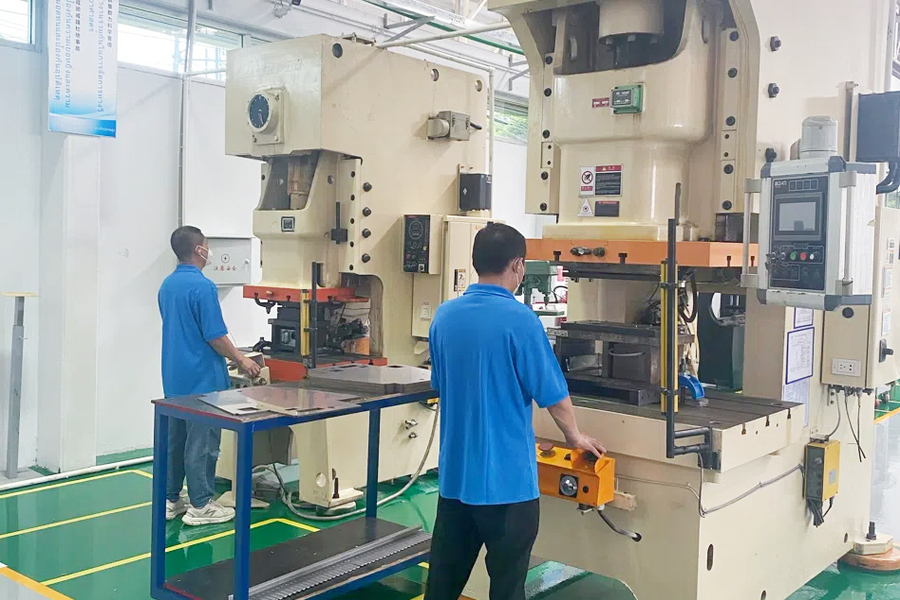
Sheet metal stamping is a cold-forming process used to transform flat metal sheets into specific shapes using high-pressure machinery and custom dies. In a stamping operation, a sheet of metal is placed between a matched set of tools (a punch and a die) mounted in a powerful press. When the press actuates, the punch forces the sheet metal into the die cavity with immense force, permanently deforming the metal into the desired shape. This process does not require heating the metal, relying instead on sheer force (often several tons) to shape it, which is why stamping machines are equipped with very powerful motors. Sheet metal stamping is sometimes simply called “pressing,” referring to the pressing action of the machine.
Each stamping setup uses a custom-designed die that contains the negative image of the part to be made. The die is typically made from hardened tool steel or carbide and fabricated with precision (often via CNC machining or EDM) to match the exact specifications of the part. When production begins, sheet metal (often fed from a roll or coil) is continuously inserted into the press. With each press stroke, the metal is cut or formed by the die into a piece matching the design. This allows manufacturers to produce large quantities of identical parts very quickly, making stamping highly suitable for high-volume production.
Key characteristics: Sheet metal stamping is known for its speed, precision, and repeatability. Because it is a cold-working technique, it can produce parts with fine details and tight tolerances without altering the metal’s chemical properties or requiring cooling time. Stamping can encompass a variety of specific operations – such as punching holes, blanking (cutting out shapes), bending, embossing, coining, or drawing – all using the same basic principle of a die and press. Once the dies are made and the process is set up, each part can be made in a matter of seconds or less, which is why sheet metal stamping is a cornerstone of modern mass production.
How Does the Sheet Metal Stamping Process Work?
The sheet metal stamping process involves several stages from initial design to finished part. Below is an overview of how a typical stamping process works, step by step:
A stamping press punches circular blanks from a continuous metal strip as the first step in a sheet metal stamping process. These blanked discs will be further formed in subsequent stamping stages.
-
Design and Die Preparation: Every stamping project begins with a part design and the creation of a custom die (or set of dies). Engineers use CAD software to design the part, and then craft the die from hardened steel or carbide, embedding the exact shape and features of the part into the die. This die-making stage often employs CNC machining and other precision fabrication methods to ensure the tooling is accurate and durable. Careful design is crucial – not only must the die form the part correctly, but it also needs to account for material behavior (like shrinkage or springback). Once the die is built and mounted in the stamping press, the production process can be set up.
-
Material Selection and Blanking: The next step is choosing and preparing the metal material. Manufacturers select a sheet metal of suitable material and thickness based on the part’s requirements (for example, choosing aluminum for light weight or steel for strength). The sheet typically comes in large coils or sheets. A process called blanking is often the first operation: the sheet is cut into flat blanks roughly the size of the final part. Using a blanking die (essentially a cutting tool shaped in the outline of the part), the press punches out the basic flat shape from the sheet, removing excess material. Blanking produces flat pieces that will be formed into final parts in later steps. In some production lines, blanking is done in-line as part of a progressive stamping process (discussed later), while in other cases pre-cut blanks are fed into separate presses for forming.
-
Forming Operations: After blanking, the metal blank undergoes one or more forming operations to achieve the final geometry. Forming is where the flat blank is bent, flanged, drawn, or otherwise shaped by the die. Depending on the part design, several forming techniques may be used:
-
Bending: The metal is bent along straight lines or angles by pressing it against a die of the desired angle. This is used for parts like brackets or enclosures with folds.
-
Drawing: A punch draws the metal into a die cavity to create three-dimensional shapes, often with depth (for example, a cup or can shape). Deep drawing is a form of this used to make deep, hollow shapes like automotive fuel tanks or aluminum cans.
-
Coining/Embossing: The metal is locally pressed with a pattern to imprint details (e.g., coin stamping or adding surface features).
-
Piercing: Punching holes or slots in the part. Piercing uses the die to cut out material creating openings (unlike drilling, piercing in stamping does not produce separate chips but rather shears the material, often pushing the slug out).
-
Flanging and Forming: Creating flares, flanges, or curved forms by stretching or compressing the metal in specific areas.
These operations might all occur in one complex die (in a progressive die setup) or in a series of separate stamping stations. Throughout the forming stage, precision control is required to ensure each bend or feature is made to specification. Modern stamping presses may use sensors and even CNC-controlled servo presses to fine-tune the force and position, achieving high accuracy for complex parts.
-
-
Trimming and Piercing: Once the part’s main shape is formed, additional cutting operations remove any excess material or create final details. Trimming uses a trimming die to cut off the leftover “flash” or edges from drawn parts, ensuring a clean profile. Likewise, any required holes, slots, or cutouts are made (if they weren’t done earlier) via piercing punches. This stage ensures the part has all the required cut features and that its outer edges meet the design dimensions.
-
Finishing and Quality Control: The stamped part is now essentially formed, but additional steps may be taken to improve its quality and performance. Deburring is typically done to remove sharp edges or small metal burrs resulting from cutting. Parts may also be cleaned or polished to remove oils and improve appearance. If required, surface treatments like plating, anodizing, or powder coating can be applied at this stage to enhance corrosion resistance or aesthetics. Throughout the stamping process (and especially at the end), quality control checks are performed – measuring critical dimensions, inspecting for cracks or defects, and verifying that tolerances are met. This ensures consistency across large production runs. Modern stamping lines often include automated vision systems or sensors that detect defects or dimensional issues in real-time. Any non-conforming parts can be rejected and adjustments can be made to the process if needed.
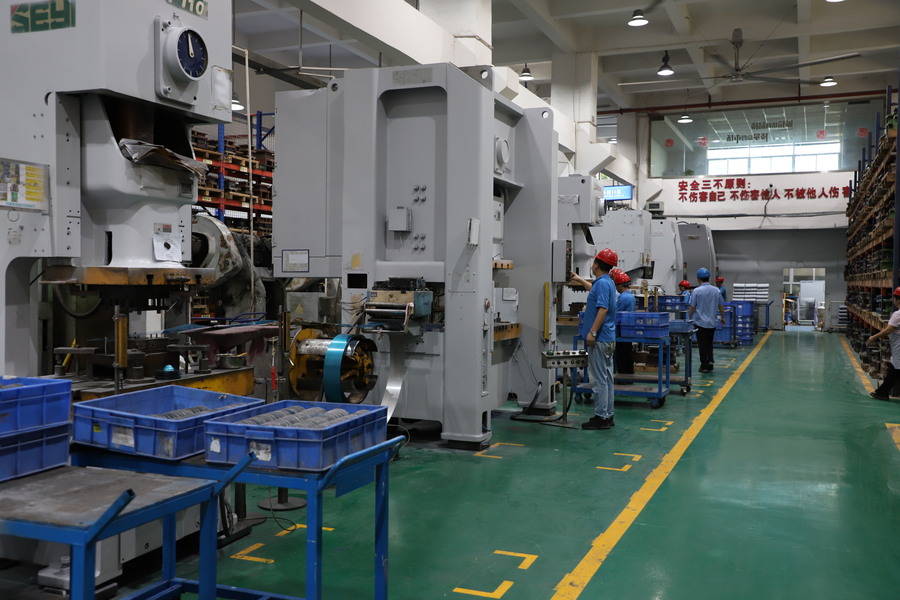
It’s important to note that sheet metal stamping is a highly automated and repeatable process. Once set up, a stamping press can cycle continuously at high speed – some presses make dozens of hits per minute – producing part after part with minimal human intervention. This high throughput is what makes stamping so efficient for large production volumes. However, setting up a stamping process requires extensive preparation (designing and machining the dies, tuning the press, testing the process) to get it running smoothly.
What Are the Main Types of Sheet Metal Stamping?
Sheet metal stamping encompasses a range of techniques and equipment setups. The main types of stamping refer to different methods by which dies and presses are used to shape the metal. Each type is suited to certain kinds of parts and production volumes. The primary stamping types include:
-
Progressive Die Stamping: This is a common high-volume technique where multiple stamping operations are integrated into a single die progression. A long strip of metal (usually from a coil) feeds into the press and moves through a series of stations within one die set. At each station, a different operation is performed (for example: the first station may punch a hole, the next bends a tab, the next trims an edge, etc.). By the time the strip reaches the final station, the part is fully formed and is cut off from the strip. Progressive die stamping is highly efficient for making complex parts quickly – with each stroke of the press, a finished part is produced once the process is in steady state. This method offers excellent precision and consistency for intricate parts and is widely used in industries like automotive, electronics, and appliances. Progressive dies also minimize waste by optimizing material usage between parts, and they reduce labor since one machine output a completed part.
-
Transfer Die Stamping: In transfer stamping, separate dies perform different operations on the part, and the part is physically transferred from one die station to the next (often by mechanical transfer arms or robots). Unlike progressive dies (where the part remains attached to the strip until the final cut), transfer stamping typically uses individual blanks that move between stations. This approach is useful for larger parts or those requiring many deep forming steps that are difficult to accommodate in one progressive die. For example, large automotive body panels or chassis components might be formed through multiple presses in sequence, each performing part of the forming process. Transfer systems are common in automotive and aerospace stamping where part sizes are large and geometries complex.
-
Four-Slide (Multislide) Stamping: Four-slide stamping is a specialized process (also known as multislide or fourslide forming) in which the machine uses four (or more) sliding tools that approach the workpiece from different directions to bend and form it. This method is particularly effective for making small, intricate parts with complex bends that might be challenging in a traditional press. Four-slide machines are often used for parts like spring clips, connectors, or fasteners in electronics and consumer products. They offer flexibility in forming multiple bends and twists in one sequence. While not as commonly known as progressive stamping, four-slide stamping is a mainstay for certain small precision components.
-
Deep Draw Stamping: Deep draw stamping (or deep drawing) is a form of stamping focused on creating deep, cup-like or cylindrical shapes from sheet metal. It involves pushing a sheet metal blank into a die cavity with a punch to plastically deform it into a new shape with a depth greater than its diameter (for example, forming a cup, can, or automotive fuel tank). Deep drawing often requires multiple stages (to progressively draw the part deeper without tearing) and may involve redrawing the part through smaller dies to achieve the final depth. It’s commonly used for making beverage cans, kitchen sinks, aerosol cans, automotive lamp housings, and other deep hollow parts. Materials need to have good ductility for deep drawing to avoid cracking. Deep draw stamping is considered one of the main stamping types because it addresses shapes that other stamping methods (which mostly deal with flatter parts) cannot easily make.
Other notable stamping-related methods include coining (for very precise shallow forming, like minting coins or small gear-like parts) and fine blanking (a specialized high-precision blanking process for extremely smooth and accurate cut edges, often used in gears or high-performance components). However, the four types listed above are the core methods used in sheet metal stamping for a majority of applications.
Each stamping method has its ideal use cases. For instance, progressive stamping excels at high volumes of small-to-medium sized parts with multiple features; transfer stamping handles very large or complex parts; four-slide is best for small bent components; and deep drawing is for deep hollow forms. In practice, a manufacturer may use a combination of these methods to produce all the various parts a product requires.
Which Materials Are Commonly Used for Stamping?
One of the advantages of sheet metal stamping is its compatibility with a wide range of metals. The choice of material depends on the part’s function, required strength, weight considerations, corrosion resistance, and cost. Some of the most commonly stamped materials include:
-
Cold-Rolled Steel and Mild Steel: Steel is perhaps the most frequently stamped metal due to its excellent balance of strength, formability, and cost. Low-carbon mild steel is relatively easy to form and is used for automotive panels, appliance enclosures, brackets, and more. High-strength steels can also be stamped (with more powerful presses) and are used when greater load-bearing capacity is needed. Steel’s popularity comes from its high strength and durability, making it suitable for structural components.
-
Stainless Steel: Stainless steels are used when corrosion resistance is paramount or for high-temperature applications. They are a bit tougher to stamp because of their strength and tendency to work-harden, but are common in kitchenware, medical devices, food processing equipment, and outdoor enclosures. Stamping stainless steel requires well-designed dies and sometimes intermediate annealing steps for very deep draws, but yields parts that are strong and rust-resistant.
-
Aluminum and Aluminum Alloys: Aluminum is another widely stamped material, valued for being lightweight and fairly ductile. Aluminum stamping is used in automotive (for weight reduction in parts like body panels and heat shields), aerospace components, consumer electronics (phone and laptop housings), and many consumer goods. Aluminum’s lower strength compared to steel is offset by its light weight and natural corrosion resistance (when alloyed correctly). It generally requires lower press forces to stamp than steel, and can be formed into deep shapes (e.g., beverage cans are deep-drawn aluminum) without cracking, provided the right alloy and temper are chosen.
-
Copper and Brass: Copper, brass, and other copper alloys (like bronze) are common for stamped parts in electrical and electronics applications. These metals are highly ductile and have excellent electrical conductivity. Stamped copper/brass parts include electrical connectors, contacts, terminal lugs, radiators (copper fins), and decorative hardware. Brass is often used for its combination of ease of forming and attractive appearance (think of brass brackets or plated trim). Copper alloys are softer, so they pose less wear on stamping dies, but their malleability means very thin features can distort if not properly supported during stamping.
-
Aluminum-Zinc Coated Steels (Galvanized Steel): In automotive and appliance industries, galvanized steel (steel sheet coated with zinc for corrosion protection) is frequently stamped to make parts that need to resist rust (for example, automotive body parts, HVAC ducts, washing machine bodies). These materials stamp similarly to regular steel, though the zinc coating can affect tool wear and require adjustments to lubrication.
-
Specialty Metals (Nickel, Titanium, etc.): For certain high-performance applications, specialty metals may be stamped. Titanium, for instance, might be used in aerospace or medical device stamping when a combination of strength and light weight is needed, though it’s challenging to form and often requires powerful presses and careful control. Nickel alloys could be stamped for electrical or heat-resistant parts, and even precious metals like silver or gold are stamped in electronics (for contacts) or jewelry. These materials are less common and typically only used when their unique properties are required, due to higher cost or stamping difficulty.
In summary, steel and aluminum (and their alloys) account for the bulk of sheet metal stamping material by volume, given their widespread use in industry. However, the stamping process is versatile enough to accommodate many metals. When selecting a material for stamping, engineers consider: will it withstand the stamping force without cracking? Does it have the needed end-use properties (strength, conductivity, etc.)? And is it cost-effective for the part’s application? The stamping die can be tailored for the material – for example, using harder tool steel and proper coatings if stamping abrasive high-strength steel, or adjusting clearances and lubricants when stamping softer metals like aluminum or copper to avoid galling. With the right setup, stamping can effectively form everything from very soft metals to very high-strength alloys.
What Are the Advantages of Sheet Metal Stamping?
Sheet metal stamping offers numerous advantages as a manufacturing method, especially for medium to high production volumes. Here are some of the key benefits:
-
High Efficiency & Speed: Stamping is extremely fast compared to many other fabrication methods. Once the tooling is prepared and the press is set up, parts can be produced in rapid succession. Automated presses can crank out thousands of parts in a short time, allowing manufacturers to meet high-volume demands and tight production deadlines. This high throughput lowers the per-part production time significantly.
-
Cost-Effective for Mass Production: Although stamping dies can be expensive to create initially, they enable very low unit costs at scale. For large production runs, metal stamping is highly cost-effective – per-part costs drop dramatically as quantities increase. The process is largely automated and requires minimal direct labor during production, which further reduces costs. Compared to processes like CNC machining (which might take minutes per part) or additive manufacturing, stamping’s ability to produce a part with one stroke means labor and machine time per part are very low after setup.
-
Precision and Consistency: Modern stamping processes can achieve tight tolerances and repeatability. A well-made die ensures that every part coming off the press is virtually identical to the last. This consistency is critical in industries like automotive and aerospace, where uniformity affects assembly and performance. Stamping is performed with guides and fixed tooling that yield exact cuts and bends, providing high precision. Even very small or intricate parts can be stamped with great accuracy when using fine tooling (hence the term precision metal stamping is often used for small, complex components).
-
Complex Geometries in One Operation: Stamping (especially progressive die stamping) can incorporate multiple features into one continuous process – such as holes, slots, bends, embosses, etc., all done within a single die or press line. This means a part that might otherwise require several separate machining or fabrication steps can be made entirely in one stamping sequence. Complex geometries and features can be produced that might be difficult or inefficient to achieve through other methods. For example, a metal bracket with several holes and bends can be stamped out complete, rather than cutting the holes in one step and bending in another. This integration reduces the need for secondary operations and simplifies the supply chain.
-
Material Efficiency & Reduced Waste: Stamping processes can be optimized to use material efficiently, especially when parts are laid out strategically on the strip or sheet. Progressive dies are designed to nest parts and minimize scrap between them. Operations like piercing relocate material rather than fully removing it (in piercing, the slug is punched out, but unlike drilling, no material is turned into chips – it’s a sheared blank) which can reduce waste. Overall, high-volume stamping tends to generate less scrap per part than many machining processes, making it more material-efficient. Any scrap that is produced (edge trim or punched slugs) is often recyclable, and many stamping facilities recycle leftover metal, aligning with sustainability goals.
-
Versatility in Materials and Thicknesses: As discussed in the materials section, stamping can work with a broad array of metals, from soft copper to high-strength steel. It also handles a range of sheet thicknesses (from thin foils and shim stock up to thick plate, depending on press capacity). This versatility means a stamping press shop can produce parts for many different sectors – from delicate electronic contacts to robust structural brackets – using the same fundamental process, just with adjusted tooling. Manufacturers can select whatever metal best suits the application (steel, aluminum, brass, etc.) and likely find a way to stamp it.
-
Improved Part Strength: Cold forming processes like stamping can impart beneficial qualities to the part. The deformation of metal during stamping often results in work hardening, which can make the part slightly stronger (as long as the material isn’t over-stressed to cracking). Also, because stamping doesn’t cut away material (except in blanking/piercing), the structural integrity of the metal is maintained. Stamped parts, especially those with formed features like ribs or embosses, can be very strong for their weight. For example, an automotive stamped sheet component might be lighter than a machined equivalent because the stamping can incorporate reinforcing ribs without adding separate pieces.
-
High Repeatability and Quality Control: Stamping processes lend themselves well to automation and in-process quality monitoring. Because the operations are repetitive and fixed by the die geometry, once dialed in, the process has high repeatability – meaning each cycle produces the same result within tight limits. This repeatability simplifies quality control since statistical process control can be applied and any drift often comes down to tool wear, which can be predicted and managed. Automated feeds and sensors can detect misfeeds or mis-formed parts immediately, which helps maintain a high quality yield.
-
Scalability: Metal stamping is easily scalable to very high production volumes. If demand increases, manufacturers can often add additional presses running the same die or use multi-cavity dies (dies that produce multiple parts per stroke) to multiply output. Whether a project calls for a few thousand parts or millions, stamping can accommodate it by adjusting the equipment and number of machines, all while maintaining consistent quality. This makes stamping a go-to method for products expected to scale up in volume.
In summary, sheet metal stamping shines when you need lots of parts made quickly, accurately, and consistently. It’s the technology that has enabled industries like automotive and consumer electronics to achieve the economies of scale we see today. While there is an upfront cost to creating the dies and setting up the process, the payoff comes in the form of low unit costs, high quality, and fast production for large quantities. For many designs, especially those intended for mass production, stamping offers an ideal mix of efficiency and precision that is hard to match with other manufacturing methods.
What Challenges Exist in Sheet Metal Stamping?
Despite its many advantages, sheet metal stamping also comes with certain challenges and limitations that engineers and project managers must consider. Understanding these challenges is important when deciding if stamping is the right process for a part and when designing parts for manufacturability. Some common challenges in sheet metal stamping include:
-
High Initial Tooling Cost and Lead Time: Stamping requires custom dies, which are expensive and time-consuming to design and manufacture. For complex parts, the tooling (including progressive dies with multiple stations) can cost a significant amount. This means stamping has a high startup cost, which can be a barrier for low-volume production or prototyping. If a design change is needed after the die is made, modifying the tooling can also be costly and slow. Companies often mitigate this by using soft tooling or CNC fabrication for prototypes to validate a design before investing in hard steel dies. Thus, stamping is most cost-effective when the volumes justify the tooling investment – small runs might be better served by CNC machining or laser cutting + bending instead of a full stamping die.
-
Design and Geometric Limitations: Not every shape can be stamped easily. Stamping works best for parts that have a uniform thickness and relatively uniform deformation. Challenges arise with designs that have very deep draws (risk of tearing or wrinkling), severe undercuts, or require variable material thickness (stamping cannot easily produce sections of different thickness like casting can). While techniques like bending and drawing cover many shapes, extremely sharp features or internal cavities that can’t be reached by a punch might be impossible to stamp. Parts may need to be re-designed to be stamping-friendly (for example, adding a slight taper to walls to allow the part to release from the die, or splitting a complex shape into multiple stamped pieces assembled later). Involving stamping engineers early in design is crucial to avoid features that cannot be formed or would cause die complications.
-
Material Springback and Tolerances: When metal is bent or formed in stamping, it tends to spring back slightly after the pressure is released – essentially, the metal tries to return toward its original shape due to its elasticity. Springback can result in parts that are out of tolerance (e.g., a bent angle might end up a few degrees off). This is a known challenge, especially with high-strength materials or large bends. To counteract springback, tool designers often incorporate compensation (over-bending in the die design or using coining hits at the end to set the shape). Even so, achieving very tight tolerances on certain dimensions can be difficult and may require careful process tuning or secondary calibration steps. Advanced techniques like servo-controlled presses can help by controlling the forming speed/pressure to reduce springback. Nonetheless, maintaining precision in stamping, particularly for complex geometries, requires vigilance in die design and process control.
-
Tool Wear and Maintenance: The repetitive high-force contact between metal sheets and dies causes wear on tooling over time. Hard metals or abrasive materials (like high-strength steel or materials with abrasive coatings) can wear down cutting edges and forming surfaces, leading to diminished part accuracy and burrs. Dies require regular maintenance – including sharpening of cutting punches, polishing of die surfaces, or even recoating/replacing tool components. Unchecked tool wear can result in defects and downtime. Thus, stamping operations must include a maintenance schedule, and tooling costs should factor in refurbishment or replacement over the production life. Using advanced tool materials or coatings (carbide inserts, titanium nitride coatings, etc.) can extend tool life, but adds to cost. Tool wear is an ongoing challenge in keeping a stamping line producing quality parts consistently.
-
Material-Specific Challenges (Cracking, Fracture): Some metals are less forgiving during stamping. High-carbon steels, certain aluminum alloys, or metals with limited ductility can crack or fracture if the stamping process is not well-optimized. For example, advanced high-strength steels (AHSS) used in modern automotive bodies require careful control and sometimes even hot stamping (heating the blank before stamping) to successfully form without cracking, due to their strength. If a part design pushes the material’s limits (like a very tight bend on a brittle material), it can lead to splits. Engineers must choose appropriate materials and sometimes apply measures like annealing between stages or adding lubricants, or even altering the part geometry to avoid extreme deformations. Finite element simulation of stamping can predict cracking or thinning issues before cutting the die, helping to address these challenges in advance.
-
Thickness and Flatness Variability: The raw material stock may have variations in thickness or material properties across different lots, which can affect stamping results. A slight change in sheet thickness or hardness can cause the formed part dimensions to shift. Stamping processes often need incoming material specifications to be tightly controlled. Additionally, the act of stamping can introduce internal stresses that sometimes lead to parts warping or twisting after ejection (especially if one side of the part is stretched more than the other). Managing part flatness or straightness can thus be a challenge, occasionally requiring a secondary flattening step or stress relief process.
-
Scrap and Material Utilization: Although stamping can be material-efficient, scrap management is a concern. The areas of the sheet that are cut away (like the web between blanked parts, or punched holes) result in scrap metal that must be collected and recycled. Poor nesting or strip layout design can lead to high scrap rates, which is essentially wasted material. In high-volume production, even a small percentage of scrap can add up to significant material cost. Therefore, engineers put effort into optimizing strip layout and may accept more complex dies if it means better material yield. Still, stamping will nearly always have some amount of offcut material. Handling, recycling, or reusing this scrap is both an economic and environmental challenge (though most scrap metal does get recycled). Efficient stamping operations aim to minimize scrap and sometimes reprocess it (e.g., melting down steel scrap to make new steel).
-
Noise and Safety Concerns: Stamping presses can be extremely loud and require robust safety measures. While this is more of a factory operation challenge than a design challenge, it’s worth noting. The high-speed impact and large forces generate noise levels that demand hearing protection for operators. Safety mechanisms (light curtains, two-hand controls, etc.) are mandatory to protect workers, as the machinery can be dangerous. Modern presses often are enclosed and sound-dampened, but occupational safety is an ever-present consideration. Environmental regulations may also limit noise or require equipment enclosures. Additionally, the large forces can pose a risk of accidents if not properly guarded. Though these concerns don’t directly affect the part design, they are part of the practical challenges of running a stamping operation.
Despite these challenges, companies overcome them with good engineering practices and technology. Upfront investment in die design, simulation, and prototyping can prevent many production issues. Continuous die maintenance and process monitoring ensure quality stays high. For issues like springback or material variation, modern solutions include servo-driven presses (for better control over the press motion) and in-die sensors/adjustments. In summary, successful sheet metal stamping requires balancing the desire for fast, cheap production with the realities of materials and physics. When done right, the challenges are managed and the benefits far outweigh the drawbacks, but it takes expertise and careful planning to get there.
What Are Typical Applications of Stamped Sheet Metal Parts?
Sheet metal stamping is used across a vast array of industries, contributing to both common consumer products and specialized industrial components. Its ability to produce high volumes of precise, durable parts makes it a go-to manufacturing process for many applications. Here are some typical applications and industries where stamped sheet metal parts are found:
-
Automotive Industry: Perhaps the largest user of metal stamping. Automobiles contain hundreds of stamped parts, ranging from body panels (doors, fenders, hoods) to chassis components and structural reinforcements. Stamping is ideal for automotive needs because it produces strong, lightweight panels and brackets efficiently. High-volume production of cars relies on stamping for everything from engine mounts, seat frames, and brackets, to clips and spring components. Even the internal components like transmission parts or heat shields can be stamped. The automotive sector also employs progressive stamping for small precision pieces (like electrical connectors and sensors) and transfer stamping for large panels. The speed of stamping aligns with the automotive assembly line’s pace, and the consistency ensures each part fits exactly during vehicle assembly.
-
Aerospace Industry: The aerospace sector uses stamping for parts of aircraft and spacecraft that require a combination of precision and light weight. Examples include sheet metal brackets, clips, and clamps used throughout an airplane’s body, as well as components like wing ribs or sections of the fuselage frame. Stamped parts in aerospace need to meet strict tolerances and quality standards. Materials like aluminum, titanium, and specialty alloys might be stamped for elements of the aircraft interior, engine components (e.g., combustor liners, heat shields in turbine engines), or mounting hardware. Stamping is chosen in aerospace when it can provide the needed shape more efficiently than machining or when producing parts in larger quantities (e.g., for commercial jet production runs). The result is high-strength, lightweight parts that help aircraft meet performance requirements.
-
Electronics and Electrical Components: The electronics industry relies heavily on precision metal stamping for small, intricate metal parts. Connectors, terminals, lead frames, and contacts are often stamped from copper, brass, or copper alloys because stamping can produce these tiny parts with excellent repeatability and fine detail. For instance, the metal prongs in electrical outlets, the pins on connectors, or the frames that hold integrated circuit chips are stamped at high volume. Even the shielding cases around electronics (RF shields) or internal chassis of devices are stamped. In electrical systems, motor laminations (thin steel sheets for motor cores) are stamped by the millions with tight tolerances. The precision of stamping ensures proper fit and function in delicate electronic assemblies, and its speed keeps up with the volume needs of consumer electronics, telecom equipment, and appliances.
-
Medical Devices and Equipment: The medical industry uses stamped parts for devices and instruments where precision and material properties are critical. Surgical instruments, clamps, springs, and components of medical device housings are often stamped out of stainless steel or titanium for cleanliness and strength. For example, components of surgical staplers, parts of medical bed frames, or brackets in imaging machines can be stamped. Stamping is also used for implantable device components (like parts of pacemakers or orthopedic implants housing) where biocompatible metals like titanium are involved – though stamping such tough materials requires specialized processes. The advantage in medical applications is that stamping can produce complex shapes that are burr-free (with fine blanking) and very consistent, which is crucial for reliability. Also, the ability to mass-produce ensures that medical device manufacturers can meet demand for disposable or single-use metal items (e.g., surgical clips, metal syringe components) with high quality.
-
Appliances and Consumer Products: Many household appliances (washing machines, dryers, refrigerators, air conditioners) have a variety of stamped metal parts. These include sheet metal panels, mounting brackets, internal frames, clips, and fasteners. Stamping provides the rigid, often galvanized steel parts that form the structure and enclosure of these appliances. Kitchen appliances like ovens and microwaves use stamped inner linings and panels. Consumer products such as home hardware (hinges, brackets, lighting fixtures), furniture components, and even tools often involve stamping. For example, the metal parts of a hinge or the frame of a pair of pliers might be stamped and then machined or assembled. The ability to stamp decorative patterns or textures is also used in consumer goods (e.g., embossed metal panels or jewelry components).
-
Industrial and Machinery Parts: In industrial machinery, stamped parts show up in conveyor systems, agricultural equipment, construction machinery, etc. Clamps, clips, washers, gears (via fine blanking), valve components, and engine parts can be stamped out for use in larger assemblies. Stamping is used for parts that might not be visible but perform essential functions – like shims, gaskets (metal ones), backing plates for brakes, etc. For instance, the automotive brake pads have a stamped steel backing plate. In HVAC systems, metal duct connectors and fins are stamped. Electrical enclosures and panels are stamped and then bent to shape for controls and switchgear. Essentially, any industry that requires large quantities of metal components with consistent quality (and that fit within the geometric limitations of stamping) is a candidate for stamped parts.
These examples illustrate the breadth of stamping applications. It’s not an exaggeration to say that almost any complex product with metal parts likely uses stamping for some of its components. Whether it’s the car you drive, the phone in your pocket (internal shield cans and connectors), the appliances in your home, or the aircraft in the sky, stamped sheet metal parts play a critical role. The technique’s combination of efficiency and precision has made it indispensable in modern manufacturing.
How Can CTT Technology (Thailand) Support Your Sheet Metal Stamping Needs?
CTT Technology (Thailand) Co., Ltd. is a leading provider of precision metal stamping services and sheet metal fabrication solutions in Southeast Asia. Based in Thailand’s vibrant manufacturing sector, CTT Technology combines advanced machinery, experienced engineers, and strict quality control to deliver world-class sheet metal parts to clients worldwide. As a one-stop metal manufacturing partner, CTT offers comprehensive metal stamping services alongside CNC machining, laser cutting, bending, welding, and finishing – allowing customers to go from concept to finished product with a single, integrated supplier.
At CTT’s Thailand facility, the emphasis is on precision, efficiency, and flexibility. The factory is equipped with modern high-speed stamping presses, CNC laser cutters, automated bending machines, and even robotic welding cells. This means CTT can handle everything from simple stamping jobs to complex assemblies that require multiple fabrication processes. For example, a customer needing a stamped enclosure might receive the stamped piece, plus any CNC-machined features, tapped holes, inserts, or welds applied – all coordinated under one roof. CTT’s expertise in both sheet metal stamping and CNC machining is particularly valuable for projects that involve tight tolerances or require a mix of stamped and machined features. The company’s engineers can advise on design for manufacturability, often suggesting where a part can be stamped for cost savings and where CNC machining might be beneficial for certain details, ensuring the final product meets all specifications.
Why choose CTT Technology (Thailand) for stamping? There are several advantages to partnering with CTT for your sheet metal projects:
-
Cutting-Edge Capabilities: CTT utilizes state-of-the-art equipment and adheres to lean manufacturing principles, resulting in efficient production and high-quality output. Their stamping lines are complemented by in-house tool and die-making capabilities, meaning they can quickly develop and refine the necessary tooling for your parts. With advanced CAD/CAM and simulation tools, CTT can validate stamping processes in advance, reducing trial-and-error and shortening lead times to production.
-
Experienced Team and Quality Assurance: The company boasts a team of skilled engineers and technicians who specialize in sheet metal and precision machining. They have professional expertise in addressing the very challenges discussed earlier – from optimizing die design to managing material behavior. Every project at CTT is subjected to strict quality control systems (they are ISO-certified and follow international standards). Inspection equipment, from coordinate measuring machines (CMMs) to optical scanners, is used to ensure each stamped part meets the required tolerances. This commitment to quality has earned CTT the trust of thousands of companies globally.
-
Flexible Production – Prototypes to Mass Production: Uniquely, CTT Technology (Thailand) is set up to accommodate both small-batch, high-mix orders and large-scale mass production runs. This flexibility is ideal for customers who might need initial prototypes or low-volume pilot production before ramping up. CTT can use quick CNC fabrication or laser cutting to create prototype parts (without waiting for full production tooling), then seamlessly transition to progressive die stamping for mass production when you’re ready. This end-to-end capability shortens your product development cycle and ensures consistency from prototype to final part.
-
Strategic Location and Cost Advantages: Being located in Thailand, CTT offers competitive manufacturing costs and convenient logistics. Thailand is a well-known hub for sheet metal fabrication in Southeast Asia, and CTT leverages this position to provide cost savings (often significantly lower labor and overhead costs, with production expenses up to 30% lower than Europe in some cases) while maintaining high quality. For companies in Asia-Pacific, working with a Thailand-based supplier can reduce shipping time and cost. Yet, CTT also regularly serves clients in Europe and North America, with efficient global shipping networks. They provide multilingual support and responsive service to international customers, making collaboration easy despite time zone differences.
In conclusion, if you are looking for sheet metal stamping in Thailand or a reliable partner to produce stamped metal parts with precision, CTT Technology (Thailand) is equipped to support your needs. The company’s blend of advanced technology, manufacturing expertise, and customer-focused service makes it well-suited for projects in automotive, electronics, medical, industrial equipment, and more. CTT Technology (Thailand) can take your project from the initial idea to full production, ensuring quality at every step and delivering parts on time and on budget.
Ready to get started? Contact CTT Technology (Thailand) to discuss your sheet metal stamping requirements and discover how their professional services can help turn your designs into reality. Whether you need a few hundred parts or a few million, CTT’s team is prepared to provide a tailored stamping solution that meets your specifications and helps you achieve manufacturing success.