

In the diverse world of sheet metal processing, bending and drawing, as key operations, have completely different meanings for the field of medical sheet metal processing, and their differences affect every step of the product from design to finished product.
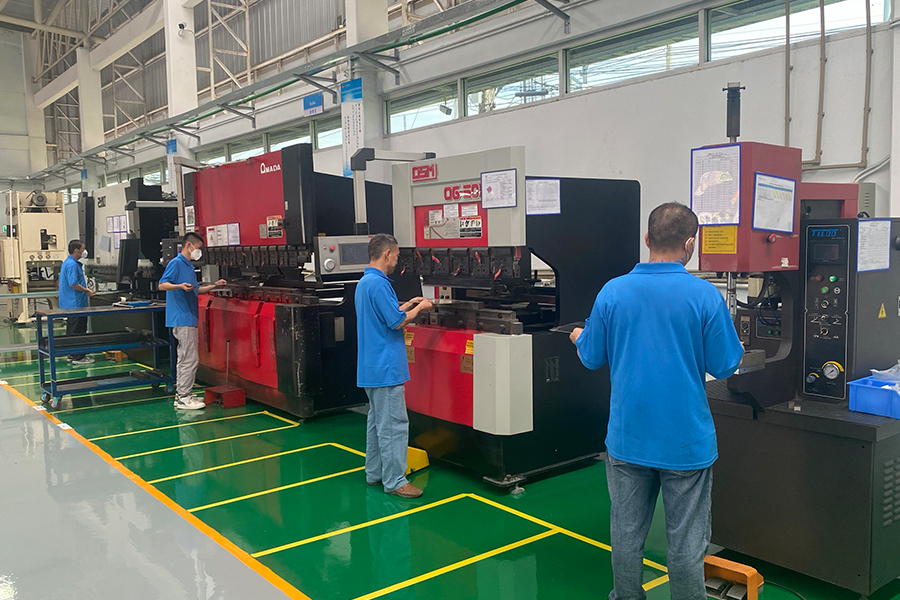
For Chuntian Machinery Thailand Branch, in the daily business of medical sheet metal processing, bending is often a sharp tool for building basic structures. Bending, in simple terms, is to bend sheet metal parts at a specific angle along a predetermined straight line. For example, in the production of metal brackets for small medical equipment, precise bending operations can quickly build a stable structure to meet the support needs of the equipment. It has outstanding advantages, simple equipment, quick operation, and relatively affordable costs. For such medical sheet metal parts with regular shapes and precise angles, bending is not only efficient, but also as long as the mold accuracy meets the standard and the equipment is accurately debugged, the bending angle can be guaranteed to be nearly perfect, making the product assembly smooth and reliable.
The deep drawing process has a unique charm in the advanced needs of medical sheet metal processing. Deep drawing drives the flat sheet metal blank to gradually evolve into a hollow three-dimensional shape with the help of the mold. When Chuntian Machinery took over the processing of the curved cover of high-end medical imaging equipment, deep drawing became the only choice. It can make the metal sheet evenly extend, shaping a smooth and design-fitting curved surface, perfectly matching the complex and beautiful appearance of medical equipment. Compared with bending, which only partially changes the angle of the sheet, deep drawing causes the entire sheet to stretch, and the internal stress is evenly distributed, giving the product excellent mechanical properties, and it is as solid as a rock when facing daily collisions, handling and other external forces.
From the perspective of supporting facilities, bending relies on conventional bending machines and highly versatile molds, and mold replacement is easy and low-cost, saving costs and time for enterprises. On the other hand, deep drawing is almost demanding on the mold. The mold must be accurately adapted to the deep drawing shape, and the details such as the fillet radius and gap must be finely polished. Any slight mistake will cause problems such as sheet cracking and wrinkling, which also leads to the high cost of deep drawing molds and long research and development time.
Focusing on material adaptability, bending is like a “master key”. Sheet metal plates of various thicknesses and materials can be processed smoothly by simply fine-tuning the bending parameters. Deep drawing is quite “picky” and prefers materials with outstanding ductility such as stainless steel and aluminum alloy. If the material has poor ductility, defects are very likely to occur during deep drawing, and the yield rate is greatly reduced.