

Why Sheet Metal Still Matters
Digital devices keep shrinking, vehicles keep getting lighter, and factories chase ever-shorter lead times—yet sheet metal remains the backbone of modern manufacturing. No other material class offers the same combination of strength-to-weight ratio, recyclability, near-infinite formability, and cost-efficient scalability. Whether you’re building a portable medical analyzer, a 5G base-station cabinet, or an EV battery tray, sooner or later you’ll need flat stock bent, cut, or joined to tight tolerances.
Teams that understand the entire sheet-metal workflow—from quoting and design-for-manufacturability (DFM) through finishing and final audit—launch products faster, slash unit cost, and avoid late-stage design changes. This guide walks through every step, highlights best practices, and spotlights the technologies pushing sheet-metal fabrication into the Industry 4.0 era.
Material Selection: Start with the End in Mind
Every downstream decision—tooling, bend radii, heat treatment, coating chemistry—depends on the alloy and gauge you lock in at the outset. Most commercial parts fall into four families:
| Material | Advantages | Typical Uses | Caution Flags |
|---|---|---|---|
| Mild Steel (CRS, HRPO) | Inexpensive, strong, weldable | Structural brackets, chassis rails | Requires paint/plating to prevent rust |
| Stainless Steel (304, 316L) | Corrosion resistant, aesthetic, hygienic | Food equipment, enclosures, surgical trays | Higher cost, greater springback |
| Aluminum (5052, 6061) | Lightweight, good thermal path | Battery housings, laptop frames | Softer—watch burrs; needs anodize |
| Copper & Alloys | Excellent electrical/EMI properties | RF gaskets, busbars | High scrap cost, scratches easily |
Rule of thumb: fix the material spec before releasing RFQs. A late switch from mild-steel to 304 stainless can blow both BOM cost and schedule.
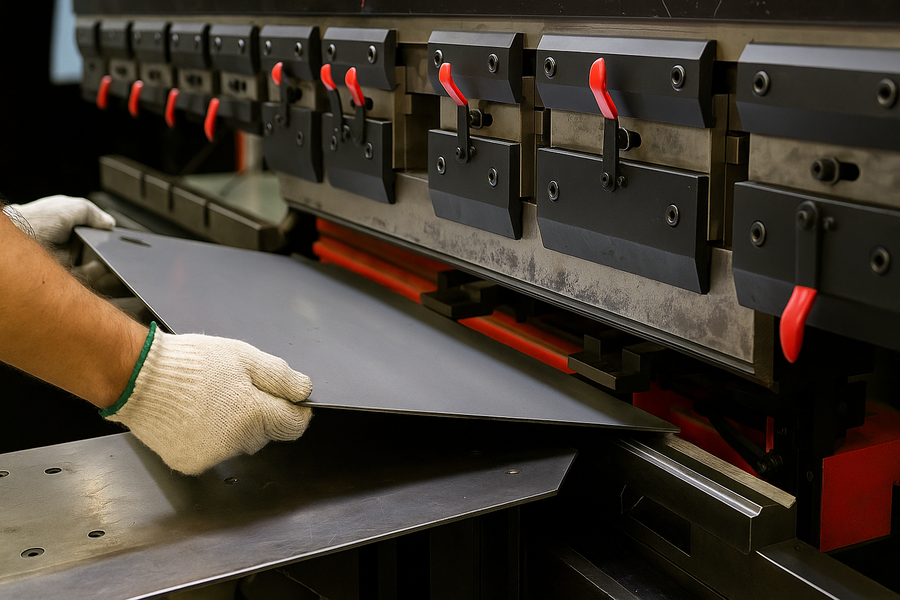
Design for Manufacturability Essentials
Uniform Bend Radius
Choose one inside radius ≥ 1 × material thickness across the entire print. Shops can run a single brake setup instead of three.
Tool-Access Geometry
Minimum flange length should be 4 × material thickness; shorter flanges can collide with the V-die or punch.
Tab-and-Slot Self-Fixturing
Add locating tabs and mating slots so parts self-align before welding. Ten minutes of CAD saves hours of layout time on the shop floor.
Standard Fasteners
Swap custom collars for off-the-shelf PEM® studs or nuts. Installation cycles drop to a second per part, and replacement inventory is cheap.
Vent-Hole Ratios
When laser-cutting louvers, keep length-to-width below 5:1 and leave at least one thickness between hole edge and bend line for clean forms.
Internal design guides that formalize these rules pay for themselves in quote speed, tooling cost, and shop goodwill.
Quoting and Vendor Selection
| Build Stage | Dominant Cost Driver | Smart Question to Ask a Supplier |
|---|---|---|
| Prototype (1–50 pcs) | Programming + machine setup | “Do you combine mixed-material day shifts to shorten lead time?” |
| Production (5k pcs +) | Tool amortization, takt time | “Can you stage progressive dies or turret nests in advance?” |
Simple prototypes often ship in under a week when the shop owns both laser and press-brake capacity; adding welding or powder coat extends lead by a few days. Progressive-die builds typically run 6–10 weeks from PO to first article, so plan pilot runs early.
Cutting Technology Choices
Fiber-Laser Cutting
Strengths: burr-free, ±0.05 mm accuracy, excels on stainless and aluminum.
Limits: plate thicker than 25 mm carbon steel may need multiple passes.
CO₂ Laser Cutting
Strengths: lower capital cost; ideal for non-metals such as acrylic.
Limits: slower on reflective metals; wider kerf.
CNC Turret Punching
Strengths: punches 100,000 ventilation holes in minutes; can form louvers or countersinks in-tool.
Limits: nibbling leaves scallops; geometry bound by tool library.
Plasma and Oxy-Fuel
Mainly reserved for heavy plate ≥ 40 mm; kerf and heat-affected zones are too large for precision enclosures.
Hybrid tip: Punch the straight holes, then finish the curved logo on the laser—often a 30 % cycle-time gain.
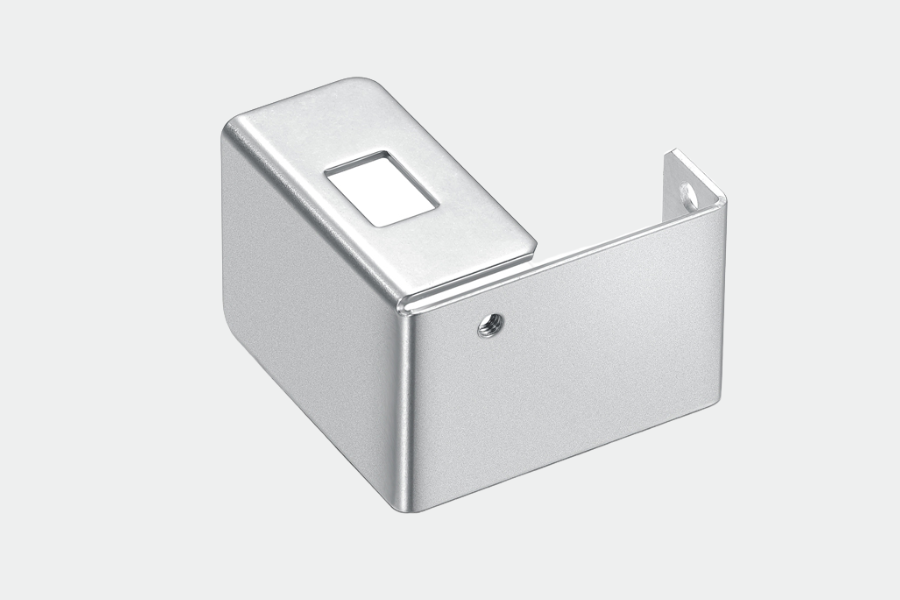
Bending and Forming on the Press Brake
Modern CNC brakes with servo back-gauges and crowning tables hold ±0.2° bend accuracy at hundreds of parts per hour. Watch two phenomena:
-
Springback — Aluminum can rebound 3–4°, stainless only 1–2°. Calibrate bend-deduction tables to each lot’s cert.
-
Tool Collision — Deep boxes collide with standard V-dies. Solutions include gooseneck punches, staged tooling, or migrating to panel benders.
Offline bend simulation and automatic-tool-change brakes are game-changers for high-mix work.
Joining Methods Beyond MIG and TIG
| Joining Process | Best For | Key Advantage |
|---|---|---|
| Spot Welding | Carbon-steel HVAC ducts | Fast, no filler wire |
| Laser Seam Welding | Battery modules, thin stainless | <1 mm distortion; >5 m/min travel |
| Clinching (TOX) | Pre-painted or coated sheets | Cold-forming—corrosion layer intact |
| Hardware Insertion | Electronics chassis | Threads installed in <2 sec |
Modular magnetic jigs speed alignment for prototypes; CNC robotic weld cells slash labor in production.
Surface Finishing Trade-Offs
| Finish | Pros | Cons | Added Thickness |
|---|---|---|---|
| Powder Coat | Durable, color range | Mask threads, bake-oven limits | +60–120 µm |
| Anodize | Hard, decorative, conductive variants | Al only; alloy can shift hue | +5–25 µm |
| Electropolish | Mirror finish, hygienic | Capital cost; SS only | Removes ≈ 5 µm |
| Zinc/Nickel Plate | Corrosion guard for steel | Passivation, RoHS oversight | +8–15 µm |
Account for thickness in gasket compression and press-fit tolerances up front.
Quality Control and Traceability
Regulated sectors demand full SPC and barcode lineage. Best-practice flow:
-
First Article Inspection—CMM plus material certs.
-
In-Process SPC—real-time dashboards of bend-angle drift.
-
Final Audit—XRF coating check and functional fit.
Top-tier shops tie every serial number to machine logs, feeding MES and PLM for a complete digital thread.
Cost-Reduction Levers that Preserve Quality
-
Gauge Optimization — Finite-element studies often show 1.6 mm 5052 equals the stiffness of 2.0 mm CRS, cutting weight 20 %.
-
One-Piece Folds — Design a wrap-around enclosure instead of welding four walls; hardware count collapses.
-
Shared Tool Modules — Progressive dies with swap-in inserts handle multiple SKUs.
-
Automated Deburr — Inline brush machines replace hand-filing, improving consistency.
Weigh ROI not just on unit price but on takt time, scrap, and downstream logistics savings.
Future Outlook: Smart Factories, Greener Footprints
Artificial-intelligence nesting drives sheet utilization above 90 %. Cobots now load press brakes between tool changes. Closed-loop powder-coat reclaim slashes overspray waste 60 %. Inline laser scanners compare finished bends to CAD in seconds and auto-tune the next cycle. Expect shorter lead times and lower carbon footprints.
Conclusion
Mastering sheet-metal fabrication—from alloy choice to final finish—demands cross-disciplinary insight. But with robust DFM rules, smart hybrid cutting strategies, and data-driven quality loops, manufacturers can launch products faster, cheaper, and with fewer surprises.
Chuntian Technology (Thailand) Co., Ltd. brings that full-spectrum expertise under one roof: state-of-the-art fiber-laser cells, auto-tool-change press brakes, ISO-certified finishing lines, and a team committed to on-time, on-budget delivery. Whether you need five rapid prototypes or 50,000 production parts, contact Chuntian Technology today and turn sheet-metal challenges into competitive advantage.